
His measurements of the time before a subject is aware of self-initiated actions have had a enormous, mostly negative, impact on the case for human free will, despite Libet's view that his work does nothing to deny human freedom.
Since free will is best understood as a complex idea combining two antagonistic concepts - freedom and determination, "free" and "will," in a temporal sequence, Libet's work on the timing of events can also be interpreted as supporting our "two-stage model" of free will.
Indeed, Libet himself argued that there was still room for a veto over a decision that may have been made unconsciously over 300 milliseconds before the agent is consciously aware of the decision to flex a finger, but before the action of muscles flexing. In his 2004 book, Mind Time: The Temporal Factor in Consciousness, he presented a diagram of his work.
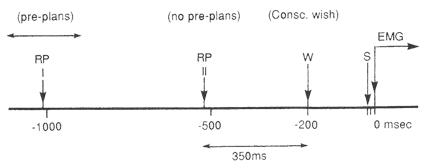
Libet says the diagram shows room for a "conscious veto."
