
The Real IPR Gauntlet: What USPTO Statistics Don’t Show
By Aaric Eisenstein
87.2% of patents in the study, per the table, were subjected to just 1 or 2 IPR petitions – so gang tackling is no big deal. But make this simple observation: If a patent is killed in its first IPR, it can’t possibly be considered for a second one.

Image Source: Deposit Photos.
I had the opportunity recently to see Chief Judge David Ruschke speak at the IPBC Conference in San Francisco. He went through a recent analysis prepared by the USPTO on the issue of “Multiple Petitions.” The people on the receiving end of this PTAB strategy usually refer to it as Gang Tackling. I want to commend the USPTO for doing the analysis to see if there is in fact an actual problem and the Judge personally for making the effort to explain their conclusions.
Judge Ruschke’s overall conclusion is that the issue of gang tackling has been portrayed as more serious than the data would justify. With due respect, I’d suggest this conclusion stems from a foundational misunderstanding of how the statistics should actually be construed. Take a look at the USPTO’s table below.

87.2% of patents in the study, per the table, were subjected to just 1 or 2 IPR petitions – so gang tackling is no big deal. But make this simple observation: If a patent is killed in its first IPR, it can’t possibly be considered for a second one.
The USPTO keeps their denominator fixed (and too large), which artificially lessens the reported percentage of patents which have large numbers of petitions filed against them. The calculation shouldn’t be 55/4,376 = 1.3% because by the time a patent faces its 7th(!) IPR petition, the universe of eligible-for-challenge patents is much smaller than during the first petition.
Or asked another way, “How many patents which survive their first IPR are subsequently left alone? How many are subjected to yet another IPR?” Worse still, “How many patents are IPR’d to death rather than ever being granted quiet title?”
The study doesn’t include sufficiently granular data to answer the question with certainty, but here’s simple math. Start with 1,000 patents. Then ask the patent owner to run a gauntlet where she has a 60% survival rate. Do it once, and 600 patents remain. Run it six times, and she’s down to 47 patents. From 1,000. Patent owners would no doubt like to see the published statistics that tell them how many IPRs they have to survive before their asset is no longer in jeopardy.
This isn’t the first time that USPTO statistics have been called out as misleading. And as before, I don’t want to imply nefarious intent. But Director Iancu has indicated that new policies, including on institution practices, are coming this summer, and it’s critically important that real-world experience – not just statistics – guides those decisions.
The nice thing about statistics is if you tell me whatever result you want, I can give you solid numbers. Remember the wise owl getting to the center of a Tootsie Pop!?! Instead, step back for a moment and ask policy questions about gang tackling:
Do we or don’t we want quiet title so patent owners definitively know what rights they have? And technology implementers can design around them?
Is it an efficient use of USPTO resources to continue revisiting the same patent?
Do we want IPRs’ page limit constraints to be actually enforced limits or simply a price-per-challenge that deep-pocketed companies can simply pay their way around?
As presently configured, the IPR process is reminiscent of the old IRA adage that Thatcher had to be lucky every day, and they only had to get lucky once. Our Patent Office’s leadership can do better than this, and I expect they will. By all means fix mistakes, but let’s not lose sight of the fact that the Patent Office exists to encourage invention and protect inventors.
www.fotavgeia.blogspot.com
By Aaric Eisenstein
87.2% of patents in the study, per the table, were subjected to just 1 or 2 IPR petitions – so gang tackling is no big deal. But make this simple observation: If a patent is killed in its first IPR, it can’t possibly be considered for a second one.
Image Source: Deposit Photos.
I had the opportunity recently to see Chief Judge David Ruschke speak at the IPBC Conference in San Francisco. He went through a recent analysis prepared by the USPTO on the issue of “Multiple Petitions.” The people on the receiving end of this PTAB strategy usually refer to it as Gang Tackling. I want to commend the USPTO for doing the analysis to see if there is in fact an actual problem and the Judge personally for making the effort to explain their conclusions.
Judge Ruschke’s overall conclusion is that the issue of gang tackling has been portrayed as more serious than the data would justify. With due respect, I’d suggest this conclusion stems from a foundational misunderstanding of how the statistics should actually be construed. Take a look at the USPTO’s table below.
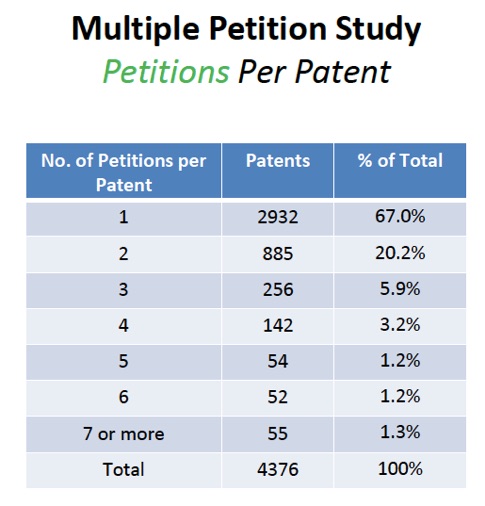
87.2% of patents in the study, per the table, were subjected to just 1 or 2 IPR petitions – so gang tackling is no big deal. But make this simple observation: If a patent is killed in its first IPR, it can’t possibly be considered for a second one.
The USPTO keeps their denominator fixed (and too large), which artificially lessens the reported percentage of patents which have large numbers of petitions filed against them. The calculation shouldn’t be 55/4,376 = 1.3% because by the time a patent faces its 7th(!) IPR petition, the universe of eligible-for-challenge patents is much smaller than during the first petition.
Or asked another way, “How many patents which survive their first IPR are subsequently left alone? How many are subjected to yet another IPR?” Worse still, “How many patents are IPR’d to death rather than ever being granted quiet title?”
The study doesn’t include sufficiently granular data to answer the question with certainty, but here’s simple math. Start with 1,000 patents. Then ask the patent owner to run a gauntlet where she has a 60% survival rate. Do it once, and 600 patents remain. Run it six times, and she’s down to 47 patents. From 1,000. Patent owners would no doubt like to see the published statistics that tell them how many IPRs they have to survive before their asset is no longer in jeopardy.
This isn’t the first time that USPTO statistics have been called out as misleading. And as before, I don’t want to imply nefarious intent. But Director Iancu has indicated that new policies, including on institution practices, are coming this summer, and it’s critically important that real-world experience – not just statistics – guides those decisions.
The nice thing about statistics is if you tell me whatever result you want, I can give you solid numbers. Remember the wise owl getting to the center of a Tootsie Pop!?! Instead, step back for a moment and ask policy questions about gang tackling:
Do we or don’t we want quiet title so patent owners definitively know what rights they have? And technology implementers can design around them?
Is it an efficient use of USPTO resources to continue revisiting the same patent?
Do we want IPRs’ page limit constraints to be actually enforced limits or simply a price-per-challenge that deep-pocketed companies can simply pay their way around?
As presently configured, the IPR process is reminiscent of the old IRA adage that Thatcher had to be lucky every day, and they only had to get lucky once. Our Patent Office’s leadership can do better than this, and I expect they will. By all means fix mistakes, but let’s not lose sight of the fact that the Patent Office exists to encourage invention and protect inventors.
www.fotavgeia.blogspot.com

Δεν υπάρχουν σχόλια:
Δημοσίευση σχολίου